How Improv Made Its Way into Our Teaching
Both Moritz Mey and Prof. Dr. Denise Fischer-Kreer have years of experience with improvisational theater. In a conversation about their shared passion, they quickly discovered the parallels between what is practiced in their hobby and the entrepreneurial skills they want to teach their students.
The Ten Parallels Between the Stage and Startup Practice
The focus is on turning off “judgment mode”—that inner voice that immediately evaluates every idea for its viability before it’s even voiced. Instead, an “experience mindset” is cultivated: experiencing, trying things out, adapting—and leaving the fear of making mistakes behind.
1. Spontaneity and flexibility: Responding to surprises without a fixed script—on stage as well as in the marketplace.
2. A Culture of Mistakes and Willingness to Take Risks: Mistakes are not interruptions, but creative resources.
3. Creativity and Innovation: New ideas at the push of a button.
4. Collaboration and Teamwork: A performance only succeeds when everyone works together. The same goes for a company.
5. Agile Decision-Making in the Moment: In volatile markets—just like on stage—waiting costs more than taking action.
6. Audience-Orientation: If you lose the audience, you lose the stage. If you ignore customers, you lose the market.
7. Resilience and Stress Management: Pressure is part of the deal. What matters is how you handle it.
8. Clarity in Communication: What isn’t immediately clear loses the stage—and the investors.
9. Courage and self-efficacy: Stepping into the unknown because you trust your own actions.
10. Bricolage: Working with whatever is at hand—creatively, pragmatically, and effectively.
The Exercises: From “Wosh-Bang-Pow” to the Art Opening
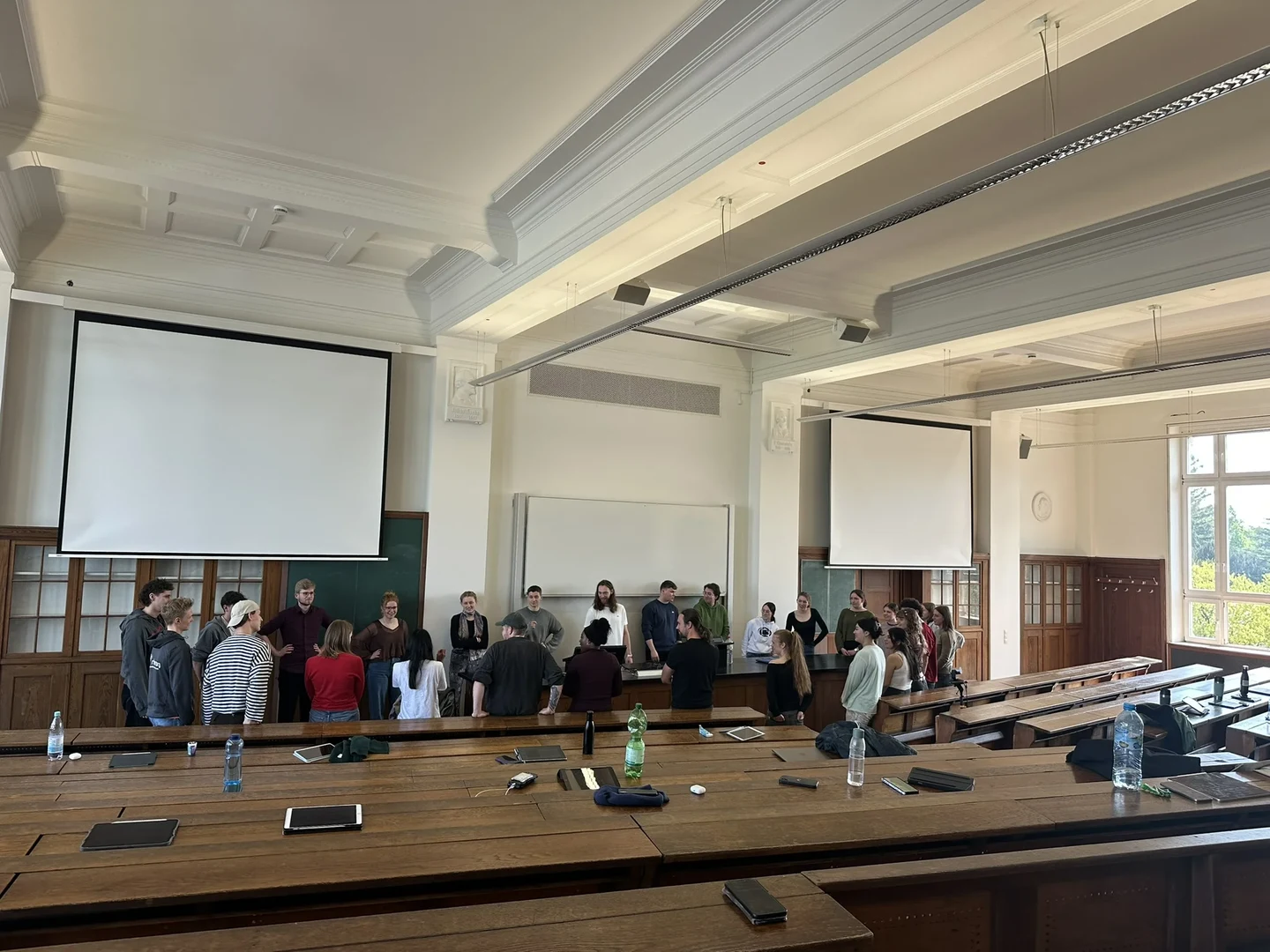
After a brief introduction to the parallels, we dive right into practice. The first rule is: “There are no mistakes—except interrupting the flow.” Through warm-ups like the association circle, the question game, and the energetic “Wosh-Bang-Pow,” students gradually break down their inhibitions. They learn to listen to one another and react in the moment, rather than searching for the perfect answer.
In the bricolage game “Little Apple Tree,” participants practice collective creation using what’s already available. One person steps into the circle, identifies themselves as part of a system, and everyone else spontaneously adds to the picture without preparation. It’s a simple yet effective exercise for thinking in systems and utilizing existing resources.
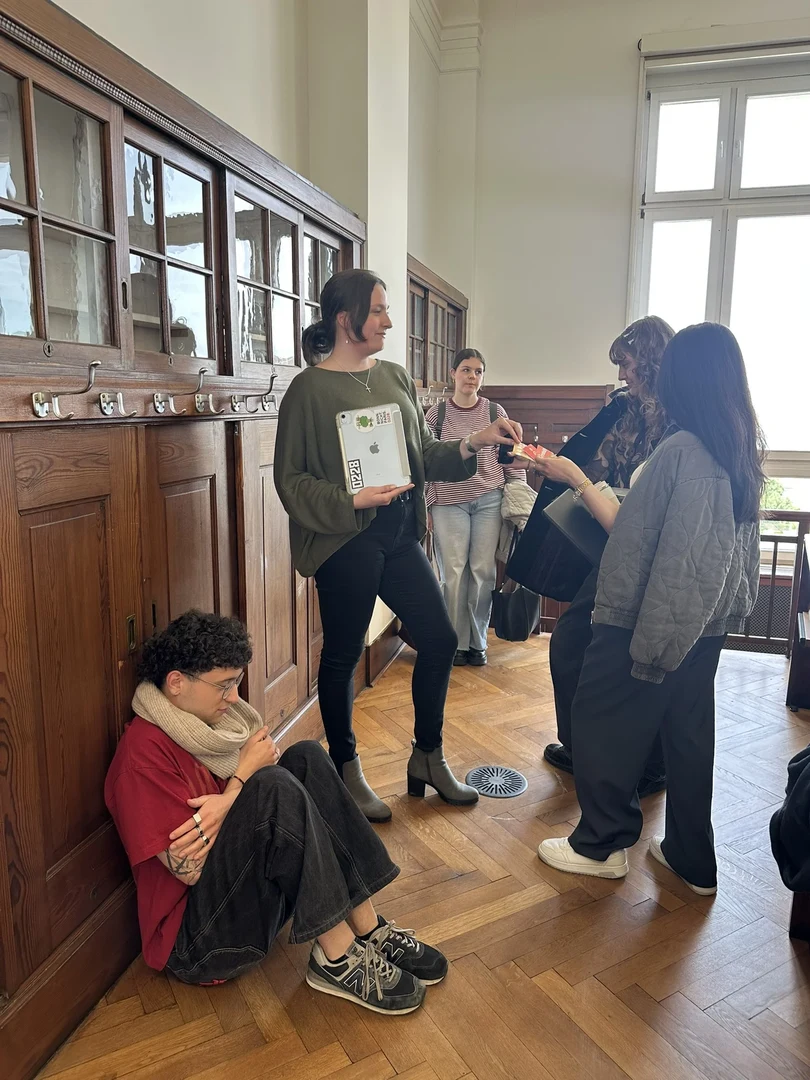
The program concludes with the Social & Environmental Issue Vernissage. In small groups, students select a social or environmental issue. They then have time to collaboratively develop a still image: a tableau vivant in which each person takes on a specific role and visually captures the essence of the problem. No text, no slides. Just bodies, space, and posture. Storytelling works this way, too.
What Remains
The effectiveness of Impropreneurwhip has been consistently evident over the years: Students get to know each other better, a team dynamic emerges much more quickly, and the quality of the presentations improves noticeably. They’ve already overcome the hurdle of speaking in front of others within the safe and playful setting of improvisational theater.
What begins on the first day carries through the entire module. We repeatedly incorporate elements of improvisation to practice presentations and strengthen team spirit. Of course, improv theater is no substitute for imparting knowledge. We therefore deliberately combine it with subject matter expertise, guest speakers, and entrepreneurial strategies. However, as a foundation for soft skills and for creating dynamic energy in the room, improv theater is ideally suited to opening up and transforming ways of thinking.
Over the course of the module, students develop real solutions and viable business models. The path to this begins with the ability to tolerate uncertainty and still step into the center of the circle.
“Improvisation is the art of being perfectly at ease with not knowing what you’re doing.” — Mick Napier